
Online Quran Reading with Tajweed Classes in Singapore
Read the Quran correctly and confidently, one-to-one with a qualified ustaz or ustazah who listens to every word.
Live online classes for children and adults that fit around school, tuition, CCA and work, all in Singapore time.
Start with 3 free classes. No payment or registration fee.
We usually reply on WhatsApp within a few minutes.
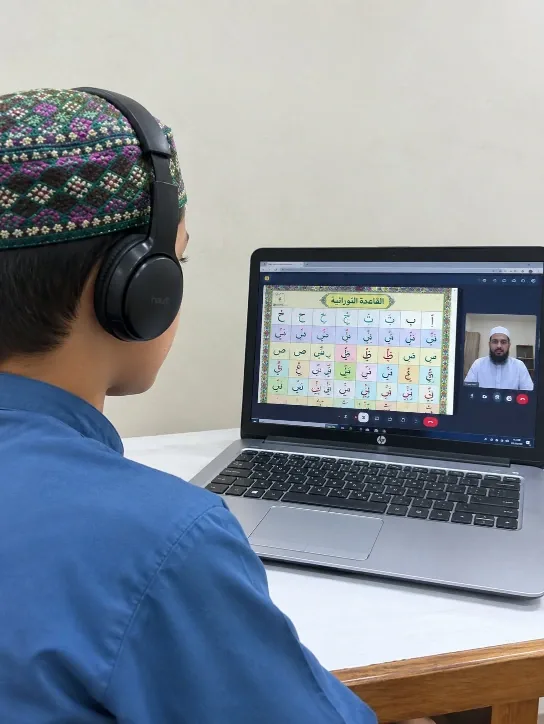
- Teaching students in Singapore since 2017
- Hafiz teachers with Ijazah
- Female teachers for girls and women
- 30-minute classes, 2 to 5 days a week
The course at a glance
| Who it’s for | Children from age 5, teens and adults, including complete beginners |
| How classes work | Live video class on Zoom, Google Meet or Microsoft Teams, one student with one teacher |
| Class length | 30 minutes (1-hour classes available, message us for the fee) |
| Days per week | 2, 3, 4 or 5, at times you choose in SGT |
| Language of teaching | English |
| Books | Noorani Qaida, Faizan-e-Tajweed and a colour-coded Tajweed Quran (PDFs provided) |
| How long it takes | Levels 1 to 3 usually take around 6 months. Reading on to khatam takes longer and depends on the student |
| Fees | SGD 35 to SGD 50 a month, no registration fee |
| Free trial | 3 classes, no card or payment details |
What “reading with Tajweed” means
Tajweed (also spelt tajwid) is the set of rules for reciting the Quran correctly. The word comes from the Arabic jayyid, which means good.
The rules cover things like:
- where in the mouth or throat each letter comes from
- which sounds are held longer, and for how long
- when a letter gets a light nasal sound (ghunnah) or a small bounce (qalqalah)
- where you can stop, and where to start again
You can read the Arabic fluently and still say some letters from the wrong place, or rush a sound that should be held. Some letters are close in sound, like ع and ء, or ص and س. Saying one instead of the other can change the word.
It also affects your daily worship. The surahs you recite in Salah and the duas you’ve learned from the Quran improve as your Tajweed does.
Read the Quran for years but not sure your Tajweed is right?
Many adults in Singapore learned to mengaji as children, finished Iqra’ or Qaida, and have read ever since. But once classes stopped, nobody listened to their reading closely, so small mistakes stayed.
The mistakes our teachers hear most often are:
- Not lengthening Madd letters. Alif, waw and ya of Madd need to be held, and many people cut them short.
- Stretching short vowels. A fathah or kasrah gets pulled out longer than it should be.
- Missing qalqalah. Letters like ق and د lose their small bounce when they carry a sukoon.
- Dropping ghunnah. The nasal sound on noon and meem disappears.
- Reading in broken pieces. Word by word, with pauses in the middle, instead of steady reading.
These mistakes are hard to catch in your own reading, even when you know the rule. Videos and apps can explain a rule, but fixing it needs someone who hears you read.
Levels: where you start and where the course takes you
You don’t need to know any Arabic to join. If you can’t read the letters yet, you start at Level 1. If you already read, you start further along.
Level 1: Noorani Qaida
Arabic letters and where each one comes from, harakat (short vowels), tanween, sukoon and joining letters into words. The Qaida goes from basic to advanced. After it, students begin reading the Quran itself, starting with the short surahs of Juz ‘Amma.
Level 2: Tajweed rules
The main rules of recitation, taught from the book Faizan-e-Tajweed and practised straight away on the Quran.
Level 3: Advanced Tajweed
The finer details of each rule, also from Faizan-e-Tajweed, with more reading from the Quran.
Then: fluent recitation until khatam
After the three levels, students keep reading the Quran with their teacher, applying every rule, until they complete it. Students receive a certificate of completion when they finish. Some students then go on to memorise the Quran in our online Tahfiz (Hifz) classes.
Not sure which level fits? During the free trial, the teacher hears you or your child read and tells you where to start. If you learned with Iqra’ before, you can carry on from where you are. We also teach Iqra if you’d rather use it: see our Iqra classes for beginners.
Levels 1 to 3 usually take around 6 months. More days a week and a little practice at home make it quicker. How long it then takes to reach khatam depends on how often you study and where you started. To plan a daily pace, try the calculator in our khatam Quran guide.
What you’ll learn
You don’t need to know any of these terms before you start. Your teacher explains each one when you reach it, and every rule is practised on ayat from the Quran, not only in the book.
We teach the recitation of Hafs ‘an ‘Asim, and the Mushaf we read from in class is printed in Hafs.
Makharij and sifaat: saying each letter properly
Where each letter comes from and how it sounds. This is where students learn the heavy letters (huroof musta’liyah), the whistling letters (huroof safeeriyah) and the lip letters (huroof shafawiyah), and where close pairs like ث and س, or ط and ت, stop getting mixed up.
Harakat, tanween and sukoon
Reading short vowels at the right length, without stretching or cutting them.
Noon sakinah and tanween
The four rules for the “n” sound: izhar (read clearly), idgham (merged into the next letter), iqlab (changed to a meem sound) and ikhfa (partly hidden).
Meem sakinah, ghunnah and qalqalah
The rules for meem with a sukoon, how long to hold the nasal sound, and the bounce on the qalqalah letters.
Madd
When to lengthen a letter and by how much. There are several kinds of Madd, each with its own length.
Lam and ra
When these two letters are read heavy and when they’re read light. The lam in the name of Allah is an easy example: heavy after a fathah or dammah, light after a kasrah.
Waqf and ibtida
Where to stop, how to stop on a word, and where to start again so the meaning isn’t broken.
Books and materials
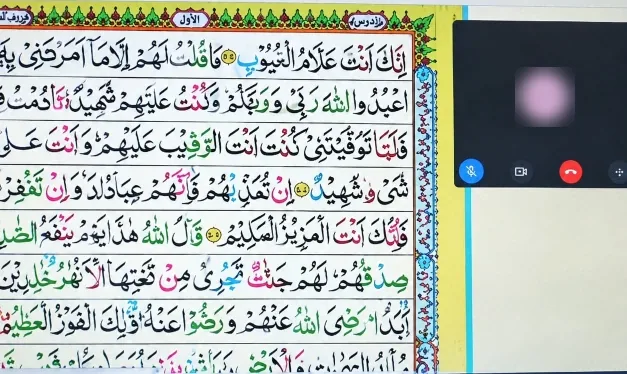
Noorani Qaida for Level 1, Faizan-e-Tajweed for Levels 2 and 3, a 16-line Tajweed Quran and the Madinah Mushaf. The 16-line Quran is colour-coded, so rules like ghunnah and Madd are marked in colour on the page. That helps a lot while you’re still learning them. You get PDF copies of the books, and the teacher shares the page on screen in class, so you don’t need to buy anything to begin.
Quran recitation classes: using the rules while you read
A student who knows the rules still has to use them while reading, at a normal pace, without stopping to think about each one. That’s what our Quran recitation classes work on. They’re online and one-to-one like the rest of the course, and recitation gets more of the class time as a student moves through the levels.
What recitation practice covers
- Reading longer passages at a steady, unhurried pace (tarteel), instead of rushing or stopping every few words
- Stopping and starting in the right places (waqf and ibtida)
- Holding each Madd for its correct length every time, not only when you remember
- Keeping the reading even and in the standard way the teacher reads it
How it’s taught
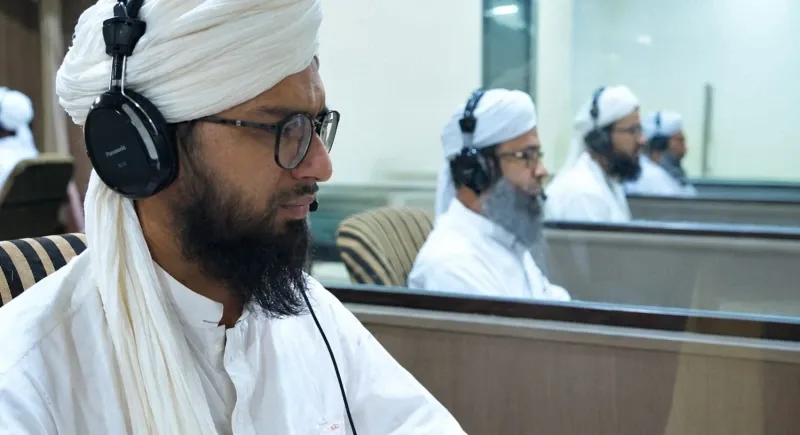
Recitation is taught through talaqqi, the traditional method of learning the Quran by listening and repeating. The teacher recites a passage, you listen, and then you recite it back. When something is off, the teacher stops you there and you read it again.
Practice between classes
Your teacher will suggest a qari to listen to and give you a small amount of reading to practise each day. Regular listening and a little reading every day help you remember the rules and use them without thinking.
If you already read with Tajweed
Some students don’t need to start from the letters. They read well but want to become more fluent, or want someone to check their reading, for example before Ramadan. In the free trial, the teacher hears you read and starts you at the stage that fits.
What happens in a 30-minute class
Most classes follow the same pattern:
- You recite the previous lesson first, so the teacher can check you’ve kept it.
- The teacher teaches the next part: a new rule, a new page of the Qaida or a new passage.
- The teacher recites it and you repeat it.
- You read from the Quran and apply the rules learned so far.
- The teacher corrects you as you read, not at the end.
A beginner’s first month
For complete beginners, the first month usually covers the heavy letters, the whistling letters and the lip letters, along with harakat and tanween. The later rules all depend on these sounds, so the teacher doesn’t rush them. Students who already read start from their own level.
Learning as an adult
Adults can start from the very beginning or continue from wherever their reading is now. Many adults worry about reading aloud and getting it wrong in front of others. In a one-to-one class there’s no one else, just you and your teacher, and the class moves at your pace. You can compare all the options on our classes for adults page.
Women and girls can learn with one of our female teachers. Classes can be early in the morning, at lunchtime or after Maghrib, so they fit around work.
“I’m from Marina Bay in Singapore and I’m 27 years old. I had read the Quran before, but I had never properly learned Tajweed… I can now recite the Quran more confidently, and I’ve learned how to follow the Tajweed rules properly. Qari Zahid Sahib has been very helpful and patient with me.”
Ahil, 27, adult student, Marina Bay, Singapore
Learning as a child
Children can start from age 5. A 30-minute class suits young children, and it fits between school, tuition and CCA without taking over the evening. Parents choose the days and the time.
You don’t need to sit in on every class, and you don’t need to know Tajweed yourself to follow your child’s progress. The monthly test and WhatsApp reports do that for you (see below).
“My daughter started learning the Quran from the very basics… Now she can recite the Quran smoothly and knows how to follow the Tajweed rules, including when to stretch a word and where to do ghunnah.”
Khamaliah Saleh, mother of an 8-year-old student, Singapore
“They first practiced with the Qaida and then started using the same rules while reading the Quran. Now both of them can recite the Quran well with Tajweed.”
Amirul Hakim, father of two students (aged 7 and 9), Novena, Singapore
Families and new Muslims
- Siblings, or a parent and child: each person has their own class, and there’s a family discount.
- New Muslims: we start from the letters and go step by step. No Arabic is needed.
- Students who finished Iqra’ or Qaida years ago: you continue from where you are.
Your teachers
We have 12 Quran teachers, 7 male and 5 female. All of them are Hafiz of the Quran and hold an Ijazah with sanad. Nine have also completed Dars-e-Nizami, the traditional course in Islamic studies.
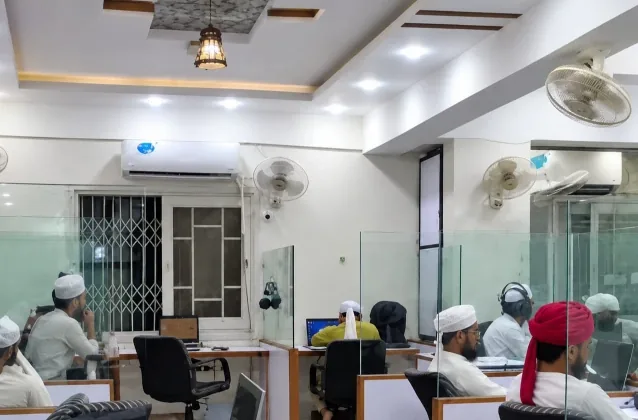
Some of our teachers:

Qari Shakeel Attari

Hafiza Alina

Qari Zahid
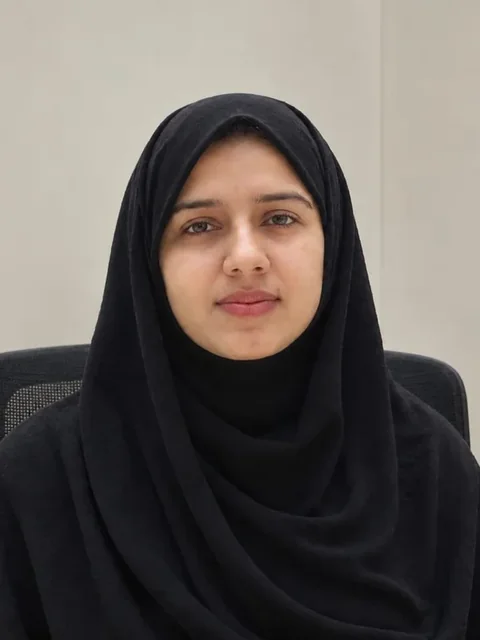
Hafiza Zainab
What does “Ijazah with sanad” mean?
In Quran teaching, an ijazah is given by a qualified teacher after listening to a student’s recitation and approving it. The sanad is the chain of teachers behind that ijazah: the teacher who gave it, the teacher they learned from, and so on. For a parent, it means your teacher’s own recitation has been heard and approved by a qualified teacher.
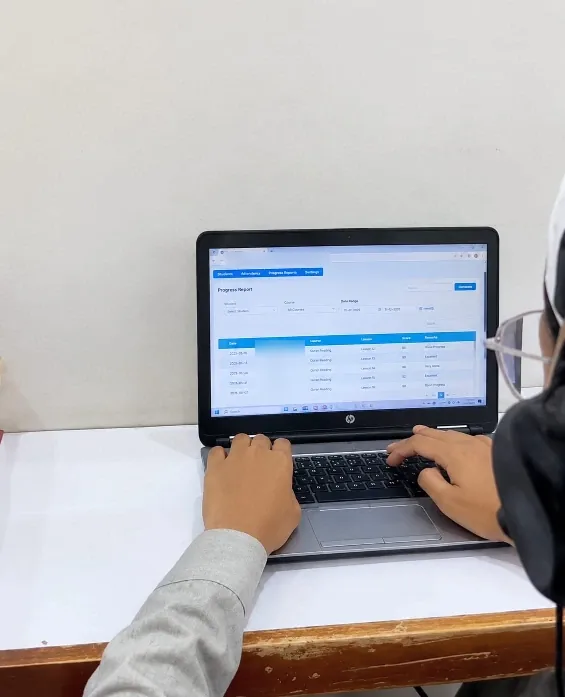
How we track progress
If you didn’t learn Tajweed yourself, it’s hard to tell by listening whether your child is reading correctly. These are the checks we use.
A test every month. The teacher checks:
- how fluently the student reads
- whether the rules learned so far are being applied
- that words are read whole, not chopped into pieces
- that the reading follows the standard way
Reports on WhatsApp. Parents receive updates on how their child is doing and what to practise at home.
Class recordings are reviewed. Our team reviews class recordings to keep the teaching standard consistent. Recordings are deleted after 30 days, and you can ask for your classes not to be recorded. Details are in our privacy policy.
A backup teacher. If your regular teacher is unavailable, another teacher covers the class so lessons can continue.
Fees and free trial
All plans are for 30-minute classes.
| Days per week | Classes a month (about) | Monthly fee |
|---|---|---|
| 2 days | 8 to 9 | SGD 35 |
| 3 days | 13 | SGD 40 |
| 4 days | 17 | SGD 45 |
| 5 days | 21 to 22 | SGD 50 |
- No registration fee.
- Islamic Studies is included at no extra cost.
- Family discount when more than one family member joins.
- Want 1-hour classes instead? They cost SGD 50–70 a month. See all class fees.
The free trial: 3 classes, free, before you pay anything, with no card or payment details. In these classes you meet the teacher, the teacher hears you or your child read and sets the starting level, and you see how learning online works for your family. If it suits you, you choose a plan. If not, there’s nothing to cancel.
If plans change
- Rescheduling: let us know at least 30 minutes before the class.
- Missed minutes: added to later classes, or made up at the weekend.
- Taking a break: you can pause classes, for example during exams or travel.
- Stopping: give one month’s notice. Any fees paid in advance for classes not yet taught are refunded.
What you need at home
A phone, tablet or laptop, a steady internet connection and a quiet corner. Classes run on Zoom, Google Meet or Microsoft Teams, and we’ll agree which one to use when we set up your classes. Headphones help a lot, because you’ll hear the teacher’s pronunciation more clearly.
How to start
Step 1
Send us a WhatsApp message. Tell us who the classes are for and roughly what they can read now.
Step 2
We match you with a teacher, male or female as you prefer, at a time that suits you.
Step 3
Take the 3 free classes. The teacher checks the level and you see if it’s a good fit.
Step 4
Choose your plan: 2 to 5 days a week.
Questions parents and students ask
Can you really learn Tajweed online?
Yes. Online Tajweed classes work well when the class is live and the teacher can hear you read. Tajweed is learned by reciting and being corrected, and on a video call the teacher can stop you at the exact letter.
My child has never read Arabic. Can they still join?
Yes. They start at Level 1 with Noorani Qaida and learn the letters first. For beginners, Tajweed starts there, with saying each letter properly.
Do I need to know Arabic?
No. You don’t need to speak or understand Arabic. You only need to learn to read the letters, and that’s part of the course.
What’s the difference between Quran reading and Tajweed?
Reading means you can read the Arabic text. Tajweed means reading it correctly: each letter from its right place, with the rules applied as you go. This course teaches both together.
What’s the difference between Tajweed classes and Quran recitation classes?
Tajweed classes teach the rules. Recitation is using those rules smoothly while you read longer passages. Here they’re one course: the rules first, then plenty of recitation practice until khatam. See the recitation section.
Do you have a separate Quran recitation course?
Not a separate course. Recitation is part of this one, and students who already read well spend more of their class time on it. The teacher sets the starting point in the free trial.
Do I need to buy any books?
No. We give you PDF copies of the books, and the teacher shares the page on screen during class.
How long does it take?
Levels 1 to 3 usually take around 6 months. It depends on how many days a week you study and how much you practise between classes. Reading on to khatam takes longer, and the time is different for each student.
What age can children start?
From age 5.
Is it too late to learn as an adult?
No. Adults of any age are welcome, and the class is just you and your teacher, so you go at your own speed.
Can I choose a male or female teacher?
Yes. We have 7 male and 5 female teachers, and girls and women can learn with a female teacher.
Are classes in English or Malay?
English.
Can I choose the class time?
Yes. You pick the days and the time in SGT: before school, after school, after Maghrib or at weekends.
Which recitation do you teach?
Hafs ‘an ‘Asim.
How much are the classes?
SGD 35 to SGD 50 a month for 30-minute classes, depending on how many days a week you choose. There’s no registration fee.
What happens in the free trial?
You get 3 free classes. You meet the teacher, the teacher checks the reading level, and you decide afterwards whether to continue. No payment details are needed.
How will I know my child is improving?
Through a test every month and progress reports on WhatsApp.
Is there a certificate?
Yes. Students receive a certificate when they complete the course.
More questions about how our classes work: read all FAQs
Try 3 classes free before you decide
Send us a WhatsApp message with who the classes are for and what they can read now. We’ll match you with a teacher and set up your first class at a time that suits you.